As an Amazon Associate, we earn from qualifying purchases. Some links on this site are affiliate links at no extra cost to you. Our recommendations are based on thorough research and editorial judgment.


Climate Control in Workshops: Humidity and Temperature Effects

Ever walked into a workshop and felt like the temperature swung from frigid to sauna in just a few minutes? You’re not alone. Keeping your workshop’s climate in check is crucial for getting the best results in your projects.
Here’s the trick: aim for temperatures between 60-90°F (15.5-32°C) and keep humidity levels around 30-55%. Why do I mention these numbers? Because when the weather’s all over the place, it can make your wood warp or crack, and that’s a nightmare for any project.
Plus, if it gets too hot, your adhesives can lose their hold. It’s pretty clear that climate control isn’t just nice to have; it’s a must.
To keep things stable, consider investing in a hygrometer and thermometer. These handy tools can help you monitor the conditions, making sure your materials and tools stay in good shape. Trust me; you want to stay ahead of any climate-related surprises.
What about practical tips? Here are a few suggestions:
- Regularly check the humidity levels. If it’s getting too high or low, adjust as needed.
- Invest in fans or dehumidifiers if you’re in a particularly humid area.
- For those really hot days, think about using air conditioning or proper ventilation to keep the air circulating.
So, why does this matter? Because your projects deserve the best chance to succeed. When you care for your workshop environment, you’re not just keeping your materials safe; you’re enhancing your overall performance and creativity.
In short, keep an eye on those temps and humidity levels. It’ll make a world of difference in your work. What strategies do you use to keep your workshop comfortable?
Key Takeaways
- Ideal workshop temperatures range from 60-90°F (15.5-32°C) to prevent wood warping and maintain tool integrity.
- Humidity levels should be maintained between 30-55% to avoid mold growth and ensure wood stability.
- Sudden temperature changes can lead to rapid moisture fluctuations, risking wood and adhesive quality.
- Regular monitoring with hygrometers and thermometers helps maintain optimal conditions for woodworking.
- Proper climate control improves air quality, reducing airborne dust and promoting a healthier workshop environment.
Understanding the Impact of Temperature on Wood Integrity

Have you ever noticed how the wood in your workshop seems to act up with the changing temperatures? It’s important to understand that temperature can really affect how wood performs and lasts over time. You see, wood is hygroscopic, meaning it absorbs and releases moisture based on humidity and temperature shifts. So, when the temperature spikes, the moisture content in the wood can change quicker than you might expect, leading to warping and cracking.
Try this: aim to keep your workshop between 60-90°F (15.5-32°C) for the best stability. Why does this matter? Well, every time the temperature rises by 10°C, the chances of chemical deterioration can double. That’s a big deal when you’re counting on your materials to last!
Effective temperature control, paired with humidity management, creates a stable environment for your wood. A good tip is to grab a moisture meter. It’ll help you keep an eye on those critical conditions, ensuring your finished products maintain their quality, even if the weather outside is all over the place. Additionally, using a dust collector with 1100 CFM airflow can help maintain air quality and reduce dust-related issues that can affect wood surfaces.
The Importance of Maintaining Optimal Humidity Levels
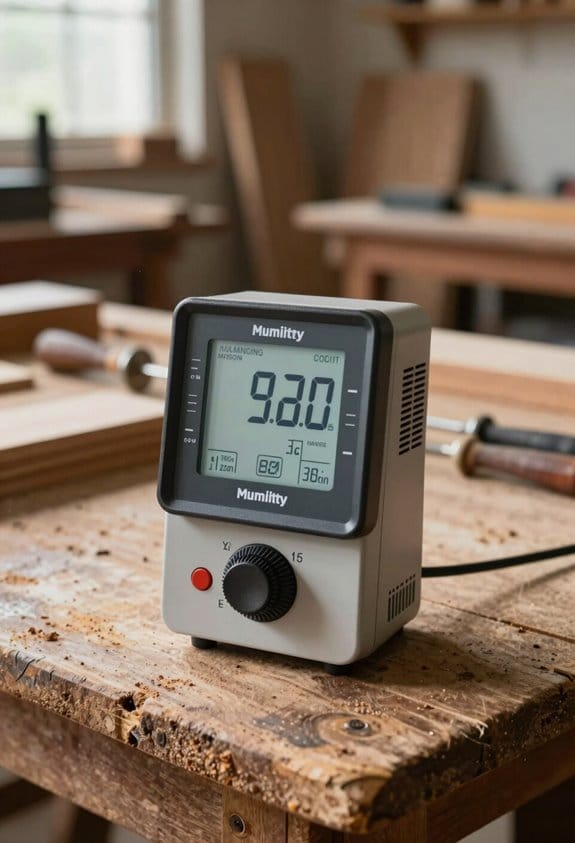
Have you ever noticed how tricky it can be to work with wood? It’s not just about the tools or your skills; the environment plays a huge role too. Keeping the right humidity levels—ideally between 30-55%—is crucial so that wood doesn’t warp or crack. I find that it really helps to have a moisture meter and hygrometer on hand. They give you real-time info about the humidity, making it easier to keep everything in check.
Excess moisture? That could lead to mold. Nobody wants that in their workshop. This is where a dehumidifier comes into play. Trust me, they’re lifesavers, especially in damp spaces. Also, don’t skip the acclimation process. Letting wood sit for about 72 hours allows it to adjust to the moisture in your workspace, making a big difference when you start working on your projects.
Proper ventilation matters too. Without it, humidity levels can fluctuate wildly, which can jeopardize your work. Adding moisture barriers can help keep things stable. That way, you can focus on creating, knowing your materials are in the best possible condition. Using devices with built-in overload protection can help safeguard your equipment while maintaining workshop climate control.
How Temperature Fluctuations Affect Workshop Tools and Materials

Have you ever noticed how sudden temperature changes in your workshop can throw everything out of whack? It’s something many of us overlook, but keeping a steady temperature is crucial for tools and materials alike. If you’re not careful, you might end up with warped wood or tools that just don’t perform like they should.
Wood’s no fan of temperature swings. When it gets too hot or cold, it can expand or contract, leading to unsightly warping or even cracking. Ideally, you want to keep your workspace between 60-90°F (15.5-32°C). The last thing you want is for your carefully selected lumber to turn into a jigsaw puzzle after a few weeks.
What about heat? Honestly, that’s a silent killer for tools. For every 10°C rise in temperature, deterioration rates can double. So, what does that mean for your gear? Well, it might not be long before you’re faced with tools that just won’t cooperate. And don’t get me started on adhesives—high heat can weaken them, risking the very integrity of your projects.
And let’s not forget about metal tools. In extreme temperatures, metal can deform, which impacts precision and makes it harder to achieve those clean cuts we all strive for. Plus, iff there’s a sudden temperature change, moisture content can fluctuate. That leads to potential headaches down the road with dimensional instability, making your hard work feel like it was for nothing.
What’s the bottom line? Effective temperature regulation is key. Don’t skip on ventilation, either; a good HVAC system can work wonders for keeping your workshop’s atmosphere steady. Using a dust extractor equipped with a HEPA filtration system can also improve air quality and protect your health by capturing fine dust created during woodworking or other projects.
Effective Methods for Monitoring Temperature and Humidity
How can you keep the right conditions in your workshop? That’s a question many of us face, especially when working with materials like wood that can be super sensitive to the environment. First up, try using hygrometers to constantly monitor humidity levels. Ideal humidity is around 30-55%; staying within this range can really help with wood stability and keep moisture-related damage at bay.
Alongside that, don’t forget about temperature. Using digital thermometers helps you stay on top of things, keeping the temperature comfortable between 60-90°F (15.5-32°C). It’s a bit of a sweet spot that most woodworkers appreciate. Regular checks of wood moisture content with moisture meters are also crucial. Aim for 6-10% moisture content to minimize issues like warping and cracking. So, why does this matter? Because nobody wants to deal with warped boards or cracked pieces after all their hard work!
Here’s the trick: consider dropping some data loggers or smart thermo-hygrometers into your routine. They collect long-term data that can transform your understanding of these critical conditions. It’s really about making informed decisions to keep your workshop running smoothly.
Additionally, using a compact dust collector with a high-efficiency MERV-13 filter can help maintain air quality and reduce dust accumulation that affects wood and workspace conditions.
To recap, monitor those humidity levels and temperatures closely, and don’t neglect your wood’s moisture content. You’ll save yourself a lot of headaches down the line. What’s your go-to method for maintaining the perfect workshop atmosphere?
Implement Effective Climate Control Practices
Ever felt frustrated when your wood keeps warping despite your best efforts? Trust me, you’re not alone. Getting the right climate control in your workshop is key to keeping your materials safe and your projects on point. Here are some practical tips that can really make a difference.
First, keep the temperature steady between 60-90°F (15.5-32°C). Fluctuations can wreak havoc on wood, causing it to bend and twist. You really don’t want to deal with that after putting in all that work. It’s also crucial to maintain relative humidity levels around 30-55%. If the air’s too damp, you risk wood movement, which is a headache no one wants. So, how do you tackle this?
Try using dehumidifiers in the muggy months and humidifiers when it’s dry. This simple switch can really help you manage those moisture levels. And before you start using new wood, give it a good 72 hours to acclimate to your workshop’s climate. This helps the wood adapt, so it doesn’t surprise you later on!
Regular monitoring is a must, too. Using hygrometers and thermometers can save you a lot of trouble. With these tools, you can keep an eye on air circulation and make quick adjustments to your heating systems. That’s how you protect your hard work, folks!
Additionally, maintaining proper power sources with weather-resistant extension cords can safeguard your electrical tools and ensure uninterrupted operation in environments prone to humidity and temperature fluctuations.
Identifying and Solving Common Workshop Climate Issues
Have you ever wondered why your woodworking projects sometimes don’t turn out as you’d hoped? It might just be the climate in your workshop. Without keeping an eye on temperature and humidity, you could be setting yourself up for failure when it comes to those materials you work so hard on.
Wood likes to stay in a cozy spot—ideally, temperatures should hover between 60-90°F (15.5-32°C) with humidity levels around 30-55%. When those numbers go off balance, you risk problems like wood warping or splitting. So, here’s the trick: get yourself a moisture meter and a hygrometer. These handy tools will help you keep track of what’s happening in your shop.
Dealing with high humidity? Air conditioners and dehumidifiers can really save the day! Conversely, on those dry days, a humidifier can do wonders for your wood. Proper insulation and good ventilation in your workshop are key—these tricks also give your wood a chance to acclimate, which helps minimize the risk of damage.
Why does all this matter? It’s simple. Maintaining the right climate ensures your woodworking projects stay strong and beautiful over time. Additionally, controlling climate also reduces airborne dust that can harm your health, especially when combined with effective dust collection systems. So, keep an eye on those conditions, and your finished pieces will thank you for it! What steps are you taking to keep your workshop in check?
Creating a Long-Term Climate Control Plan for Your Workspace
Have you ever walked into your workshop only to feel like you’re in a sauna one day and a freezer the next? Finding that sweet spot for temperature and humidity is key to keeping your woodworking projects at their best. Ideally, you want to keep temperatures between 60-90°F (15.5-32°C) and humidity levels in the range of 40-55%.
To keep tabs on these conditions, investing in a good hygrometer and digital thermometer will be your best friends. They help you create a stable environment that’s essential for your wood’s dimensional stability. So, here’s the trick: if you notice your workshop isn’t quite right, those gadgets will point you in the right direction.
Temperature swings can be a pain, but you can tackle them with some smart insulation techniques and a decent HVAC system. Frankly, a reliable heating and cooling solution goes a long way in preventing those annoying fluctuations. If winter rolls around and your shop feels like an icebox, consider adding a few portable heaters to get you through those chilly months.
Moisture levels can be tricky, especially when it’s cold outside. A consistent environment means fewer headaches when it comes to potential warping or cracking of your precious pieces. Regularly maintaining your climate control equipment will keep everything running smoothly for the long haul.
For powering your climate control devices safely and reliably, it’s important to use heavy-duty extension cords with ETL certification to ensure electrical safety in your workshop environment.
Frequently Asked Questions
What Tools Can I Use to Measure Humidity in My Workshop?
We can use hygrometers, both digital and analog, to measure humidity in our workshop. For accuracy, we should consider portable humidity meters with data logging options and employ calibration techniques to guarantee reliable readings that protect our tools.
How Can I Prevent Humidity-Related Rust on Tools?
Well, if we were knights in shiny armor, we’d use rust prevention techniques like protective coatings and humidity control methods. Regular maintenance, moisture absorption products, and good air circulation can keep our tools in top shape.
Is a Dehumidifier Necessary for All Workshops?
No, a dehumidifier isn’t necessary for all workshops. However, its benefits include humidity control, moisture absorption, and aiding workshop ventilation. We can enhance climate monitoring, ensuring ideal tool preservation in our unique workshop environment.
What Signs Indicate Poor Climate Control in a Workshop?
We can spot poor climate control through visible moisture damage, rust on tools, temperature fluctuations, inadequate air circulation, insulation issues, and inefficient ventilation systems, all signaling a need for better humidity control and tool maintenance.
Can Plants in the Workshop Affect Humidity Levels?
Yes, plants’ benefits can greatly affect humidity levels in our workshop. They help with humidity regulation, enhance air quality, and moisture absorption, promoting a humidity balance that’s essential for tool preservation and overall workshop environment health.


